1. Open the matching tool
Aorta, cardio-oncology, bubble study, geometry, ventricular function, diastole, Wilkins, RV–PA coupling. Research tools sit in their own group.
 echo-wizard.com
For the reporting desk
Echo Wizard is for the echocardiogram you are reporting now. Enter this study and the previous one. Aorta, cardio-oncology and bubble study each return a finished suggestion you can check and copy.
Built for fully trained echocardiographers. The report stays yours.
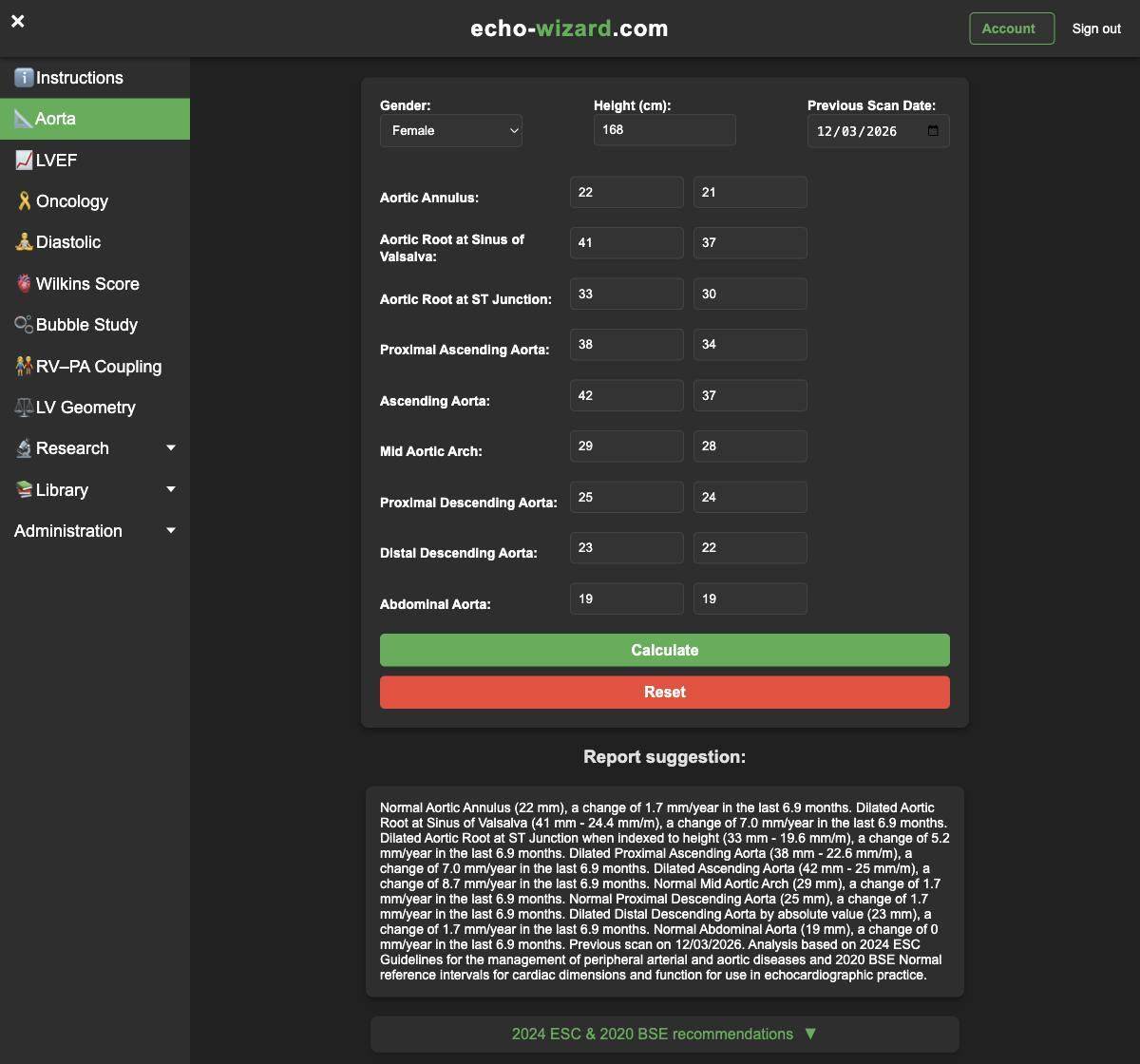
The slow part is the comparison, the index, and the paragraph you would otherwise assemble from memory between patients.
Enter sex, height, and each segment you measured today and last time. The suggestion gives the absolute size, the indexed size, and the change in millimetres per year. In the example above the sinus of Valsalva is 41 mm (24.4 mm/m), up from 37 mm, a change of 7.0 mm/year over 6.9 months.
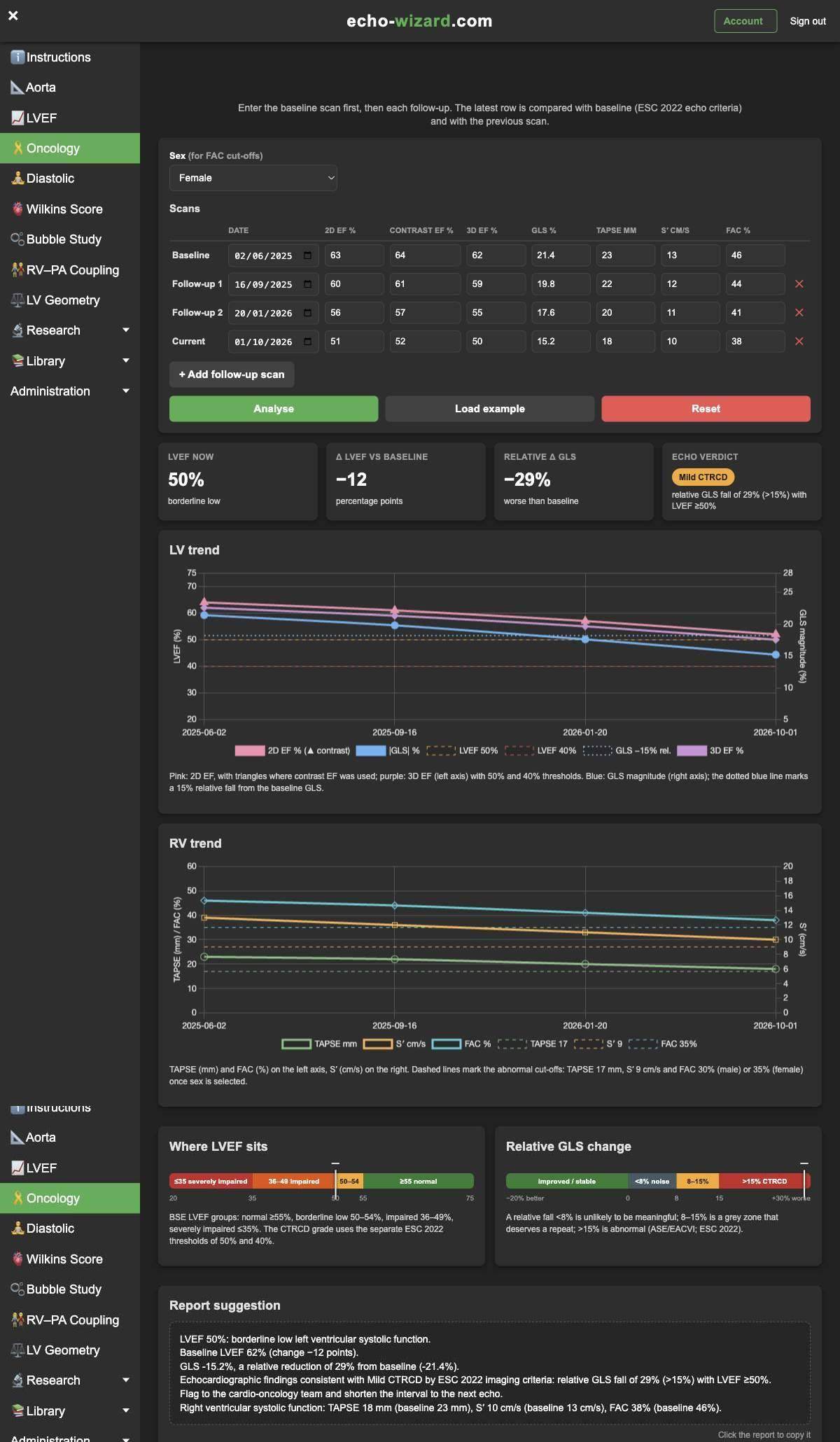
One row per scan: date, 2D ejection fraction, contrast, 3D, GLS, TAPSE, S′ and fractional area change. The latest row is set against baseline. The example runs from June 2025 to October 2026 and lands on mild CTRCD, with the charts drawn from every visit.
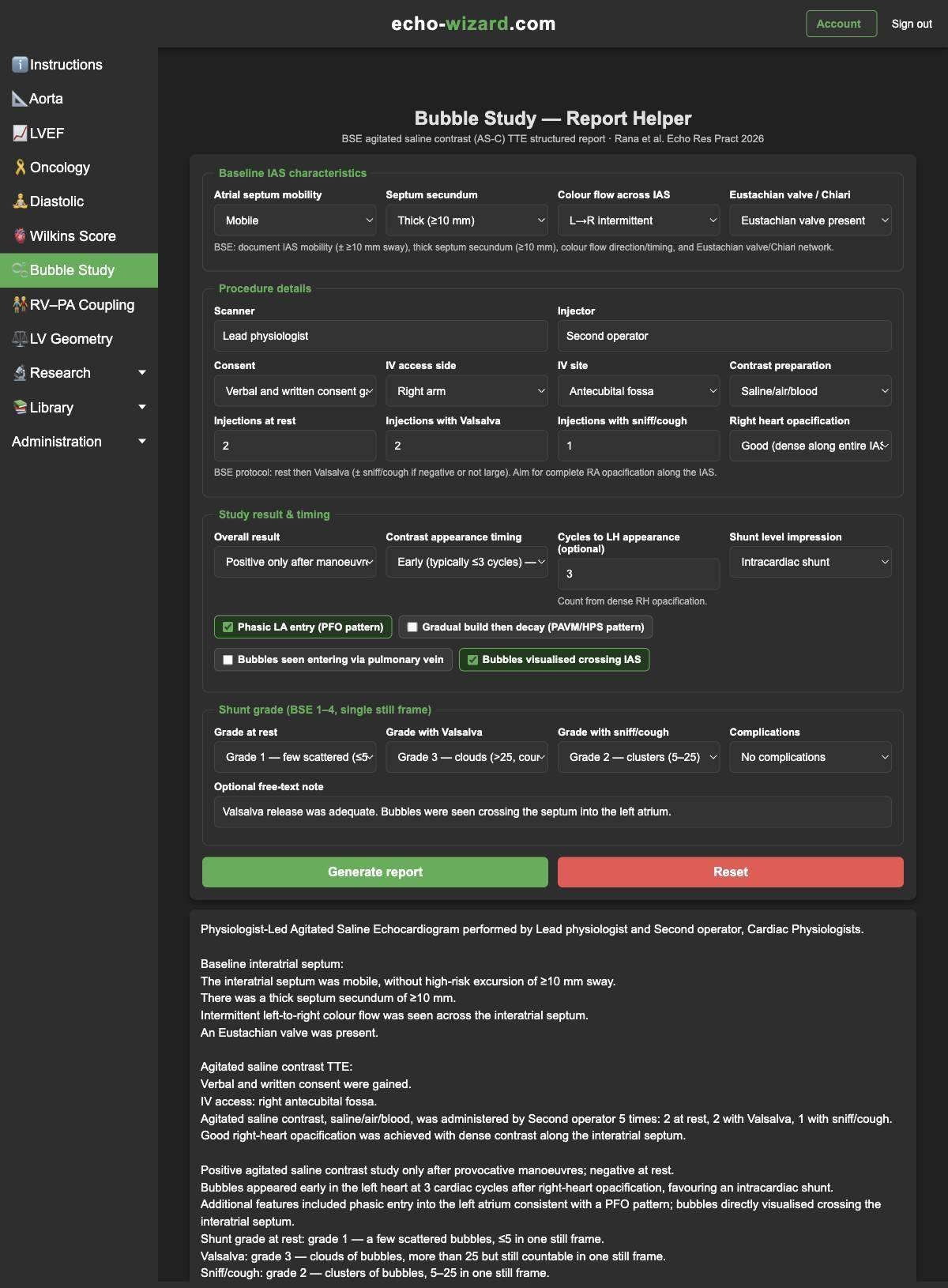
Septum, consent, injection counts, timing, shunt level and the BSE grade at rest, with Valsalva and with sniff. The example is positive only after a manoeuvre, early at 3 cycles, grade 3 with Valsalva.
Aortic intervals, the ESC 2022 cardio-oncology imaging criteria and the bubble-study structure stay on the server. Two people entering the same numbers get the same starting paragraph.
Strain, congestion, device measurements and infiltrative patterns are there for the unusual case. They are labelled research. They do not pretend to be the clinical report.
Aorta, cardio-oncology, bubble study, geometry, ventricular function, diastole, Wilkins, RV–PA coupling. Research tools sit in their own group.
Put in the measurements you acquired, and the earlier ones when the comparison matters. Leave a field blank when you did not measure it.
Read the suggestion against the images. If it matches, copy it. If it does not, change it before it reaches the report.
Membership
£59 a year
A new account includes 7 days. After that, an active membership opens the reporting tools, the instructions and the reference posters.
You enter the measurements from the study. It drafts the report text for that part of the examination. You read it against the images, change anything that does not match, and copy it into the report.
Aortic size by segment, with the previous study and the change per year. Cardio-oncology, with 2D, contrast and 3D ejection fraction, GLS and right-ventricular measures on every visit. Agitated-saline bubble studies, from the septum through to the shunt grade. Also left-ventricular geometry, ventricular function, the Wilkins score, diastolic function and RV–PA coupling. Research screens are separate and labelled as research.
No. It is for fully trained echocardiographers. It drafts wording from the numbers you enter. You remain responsible for every number and every line in the report.
The clinical tools send what you type to the server, draft the text, and do not keep that calculation as a patient record. Echo Wizard is not the archive of the study.
Fully trained echocardiographers, cardiac physiologists and cardiologists reporting transthoracic studies. Membership is £59 a year, with 7 days on a new account.
For informative use only. Echo Wizard is for fully trained echocardiographers. It drafts report text from the measurements you enter so a department can keep wording consistent. It is provided as is. You remain responsible for checking every number before it goes into a report. It does not replace your own judgement.