
Home / Cardio-oncology
Cardio-oncology tool
Cardio-oncology echo: LVEF, GLS and CTRCD across every scan
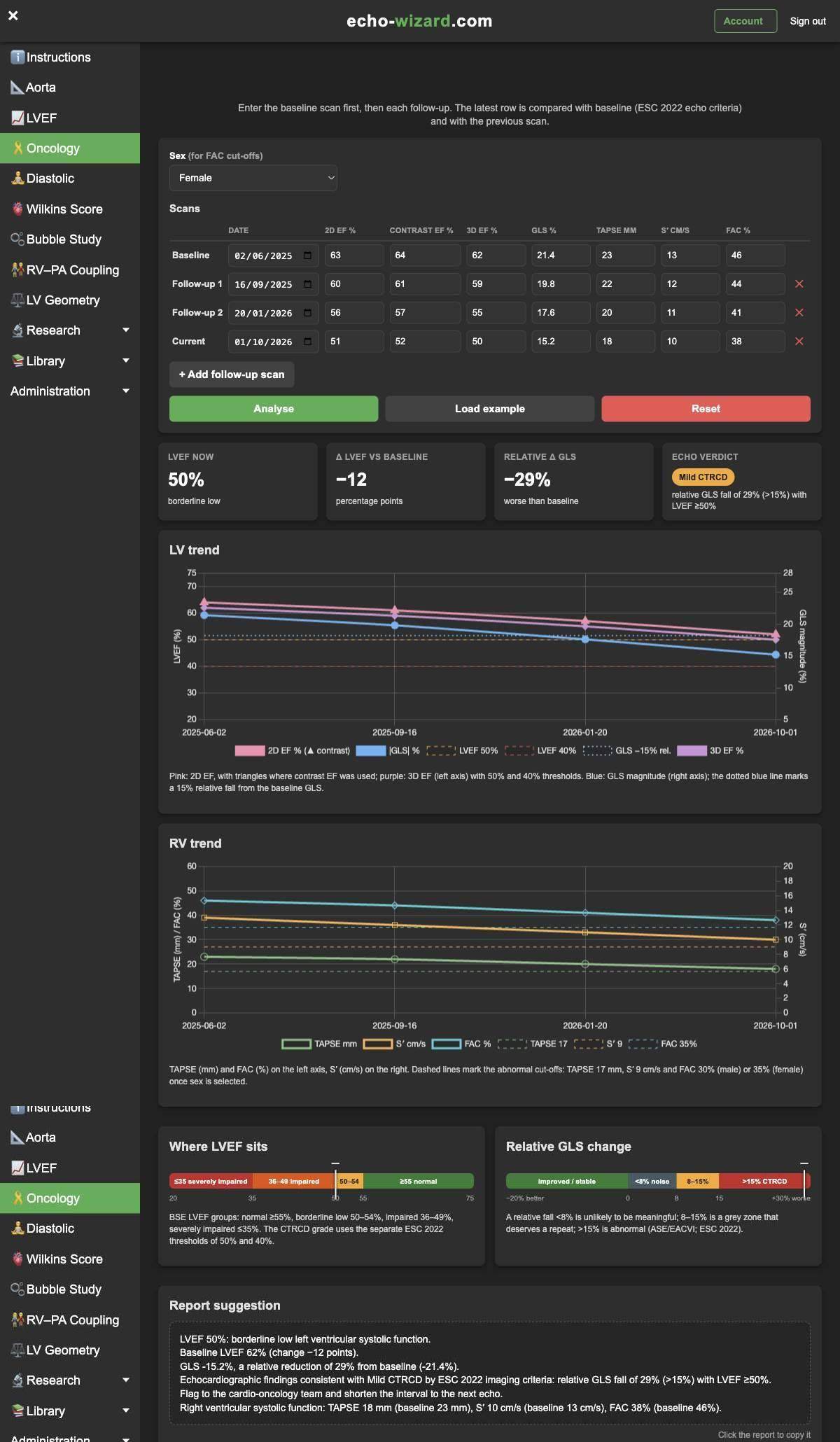
Enter the baseline study and each follow-up during cancer therapy. Echo Wizard sets the latest scan against baseline, grades cancer therapy-related cardiac dysfunction (CTRCD) by the ESC 2022 imaging criteria, and draws the left- and right-ventricular trends.
What you enter
One row per scan, starting with the baseline. Each row can hold the date, 2D ejection fraction, contrast ejection fraction, 3D ejection fraction, GLS, TAPSE, S′ and fractional area change. Add as many follow-ups as the patient has had. Sex is used for the fractional area change cut-off.
What comes back
- The current LVEF and its category, the change in points from baseline, and which method was used. When 3D is present at both ends, it is preferred.
- The current GLS and the relative change from baseline.
- A CTRCD grade, none, mild, moderate or severe, with the reason that triggered it, for example “relative GLS fall of 29% (>15%) with LVEF ≥50%”.
- A caveat when the change does not meet the criteria but deserves a closer look, such as an LVEF fall that stays at or above 50%, or a relative GLS fall in the 8–15% grey zone.
- The right ventricle in the same paragraph: TAPSE, S′ and fractional area change, each against baseline.
- Trend charts for both ventricles, drawn from every visit.
Which criteria it uses
The grading follows the imaging definitions of asymptomatic CTRCD in the 2022 ESC Guidelines on cardio-oncology: LVEF thresholds of 50% and 40%, a 10-point fall, and a relative GLS reduction above 15%. The guideline is named on the tool and in the report text.
Questions about the cardio-oncology tool
Does it compare with baseline or with the previous scan?
The CTRCD grade compares the current scan with baseline, as the ESC definitions do. The charts show every scan in between, so a gradual decline is visible.
What if GLS was not measured at baseline?
The relative GLS change needs both values. Without a baseline GLS the grade relies on LVEF alone.
Can I mix 2D, contrast and 3D ejection fractions?
Enter whichever you measured. The tool compares like with like, preferring 3D when it is present at both baseline and the current scan.
See also the aorta tool, the bubble study tool, and all three examples entered in full.
For informative use only. Echo Wizard is for fully trained echocardiographers. It drafts wording from the numbers you enter. You remain responsible for every number and every line in the report.