
Home / Prosthetic valve
Prosthetic valve tool
Prosthetic valves in the echo report: aortic, mitral, pulmonary and tricuspid
Choose the position, then the model and labelled size if you know them. Echo Wizard grades your Doppler measurements against the ASE 2024 criteria for that position, sets them against the published normal values for that exact valve and size, works out patient-prosthesis mismatch, and compares with the baseline study after implant.
Any replaced valve: aortic, mitral, pulmonary or tricuspid
The tool is not only for aortic valve replacement. Each position has its own criteria from the ASE 2024 guideline on prosthetic valve function:
- Aortic, surgical or TAVI (Table 5): peak velocity, mean gradient, Doppler velocity index, EOA by continuity, acceleration time and acceleration to ejection time ratio.
- Mitral (Table 11): peak E velocity, mean gradient, VTI prosthesis to VTI LVOT ratio, EOA and pressure half-time.
- Pulmonary (Table 15): peak velocity and mean gradient, with the lower limits for a homograft.
- Tricuspid (Table 19): peak E velocity, mean gradient, pressure half-time, EOA and VTI ratio, with separate limits for mechanical valves.
The form shows only the measurements that apply to the position you choose.
Normal values for 121 valve models
A prosthesis is only abnormal compared with what that model and size normally achieve. Pick the model and labelled size and the tool looks up the published normal EOA and gradients: 70 aortic models, surgical and transcatheter (including SAPIEN, SAPIEN XT, SAPIEN 3, CoreValve and Evolut R), 35 mitral, 8 pulmonary and 8 tricuspid, 502 labelled sizes in all. The values come from the appendix of the ASE 2024 guideline (Tables A1 to A9) and the EACVI 2016 recommendations.
Each measured value is set against the mean ± SD for that size, and anything beyond 2 SD is called out. Where a table gives a median and range instead, it is quoted as published. If the valve is not listed, the position criteria still apply.
What you enter
- The position, and whether an aortic valve is surgical or transcatheter. For pulmonary and tricuspid valves, the valve type: bioprosthesis, mechanical, homograft or transcatheter.
- The model and labelled size, if known.
- Height and weight for aortic and mitral valves, used for the indexed EOA.
- The Doppler measurements for that position. Leave empty what you did not measure.
- Optionally, the baseline study 1 to 3 months after implant: mean gradient, DVI and EOA.
What comes back
Each parameter is graded as normal, possible stenosis or suggesting significant stenosis. The verdict separates true stenosis from high flow or mismatch using the DVI and acceleration time, as the guideline does. With a baseline study, the change is graded as no, possible or significant structural valve deterioration (Table 6). Patient-prosthesis mismatch is graded from the indexed EOA (Table 7), with the BMI ≥ 30 thresholds when they apply, and the projected indexed EOA is worked out from the reference EOA so you can see whether the mismatch was expected from the valve size.
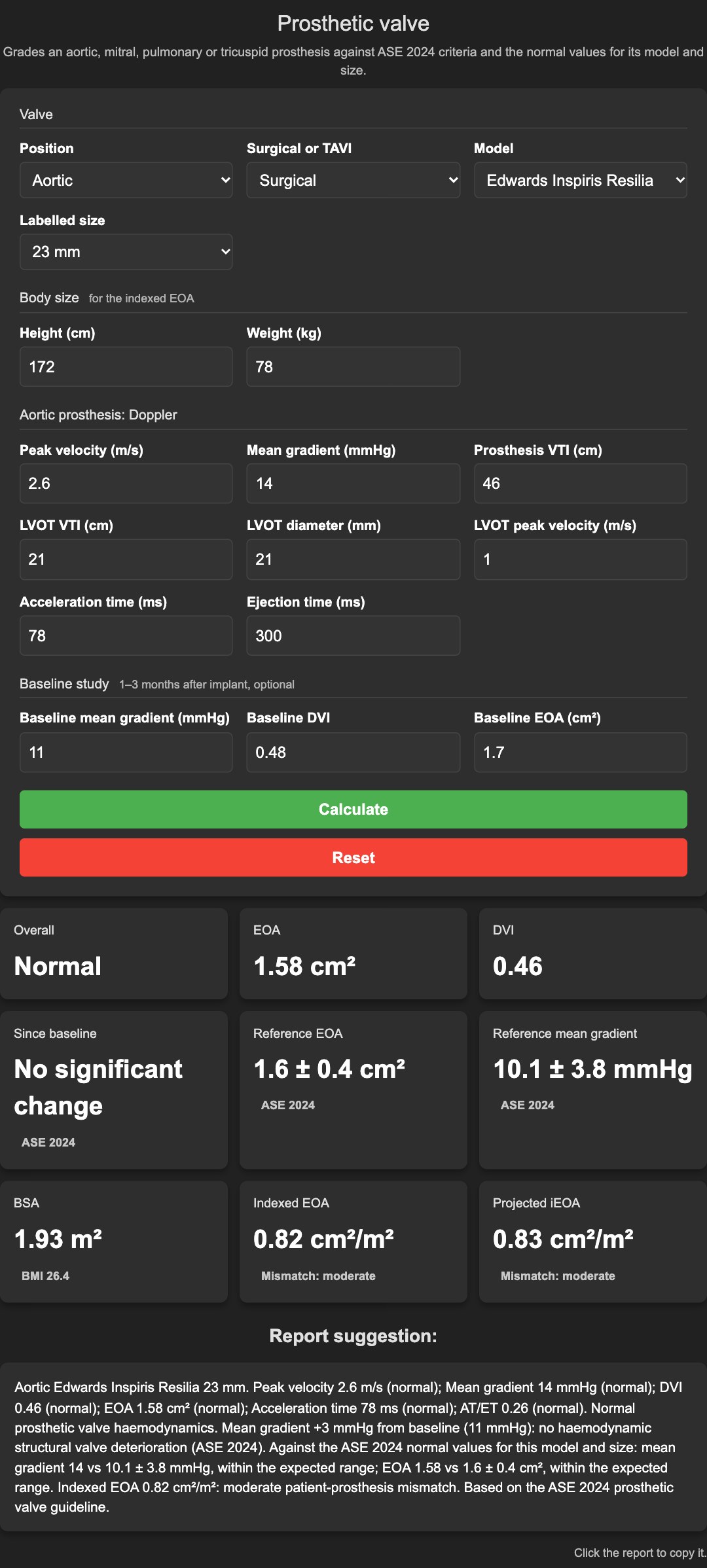
The example above returns, in part: “Mean gradient +3 mmHg from baseline (11 mmHg): no haemodynamic structural valve deterioration (ASE 2024). Indexed EOA 0.82 cm²/m²: moderate patient-prosthesis mismatch.”
Which guidelines it uses
Zoghbi WA et al. Guidelines for the evaluation of prosthetic valve function with cardiovascular imaging. J Am Soc Echocardiogr 2024;37:2. Reference EOAs for some surgical valves follow Lancellotti P et al., EACVI recommendations, Eur Heart J Cardiovasc Imaging 2016;17:589. The criteria and normal-value tables are listed under the tool, so you can check every cut-off.
Questions about the prosthetic valve tool
Is it only for aortic valve replacement?
No. It grades aortic (surgical and transcatheter), mitral, pulmonary and tricuspid prostheses, each against the ASE 2024 criteria for that position.
What if I do not know the valve model?
Leave the model as not listed or unknown. The position criteria still apply; only the comparison with the model's published normal values is left out.
Why enter the baseline study?
The ASE 2024 guideline judges structural valve deterioration against the study 1 to 3 months after implantation. With the baseline mean gradient and DVI or EOA, the change is graded as none, possible or significant.
How is mismatch worked out?
The EOA by continuity is divided by the body surface area from height and weight, and graded with the ASE 2024 thresholds for the aortic or mitral position, using the lower thresholds when BMI is 30 or more.
See also the aorta tool, the cardio-oncology tool, and examples entered in full.
For informative use only. Echo Wizard is for fully trained echocardiographers, cardiac physiologists, clinical scientists and cardiologists. It drafts wording from the numbers you enter. You remain responsible for every number and every line in the report.